Introduction
I often use online impedance calculator for quick microstrip, stripline and grounded CPW line dimension calculation. However, they often are not quite good enough. For example when microstrip is covered with solder mask its impedance drops due to dielectric of the mask and the mask increases effective permittivity. Most calculators can't give impedance of the line in that case and it can be significant for thin substrates. Another common issue is unusual transmission lines such as asymmetric stripline, embedded microstrip or lines over ground plane cuts (for example cutout under SMD capacitor or resistor pads). Many calculators are also unable to estimate line losses.
At work I usually use 2D transmission line field solver to simulate cross-sections (E.g., Ansys 2D extractor, OpenParEM, and many others), but it's quite lot of effort to open the program, draw the geometry, setup simulation parameters, and then simulate it. User interface of those programs also often leaves a lot to be desired.
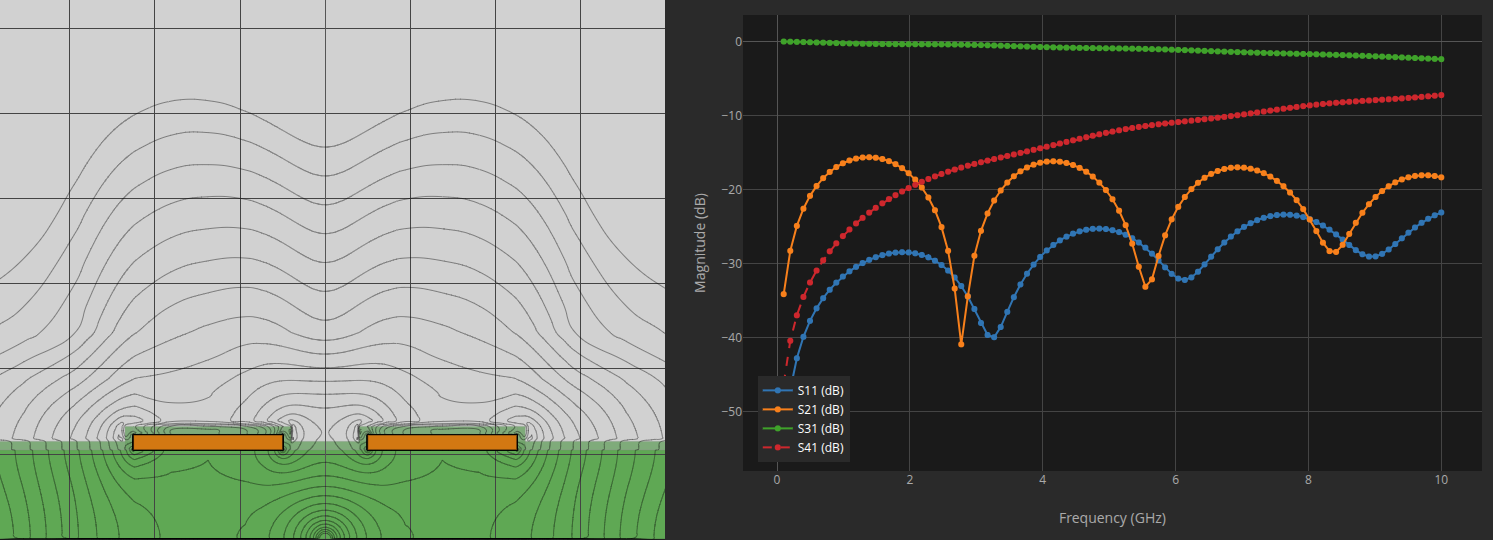
I decided to make my own online 2D transmission line field simulator that works entirely in local browser. It's fast to open and transmission lines can be added just by inputting parameters just like with simple impedance calculators. It supports microstrip, stripline, and grounded CPW lines, both single-ended and differential. There's also support for adding solder mask, top-dielectric for embedded microstrip, cutout in ground plane, and metal enclosure around the line. It calculates both dielectric and conductor loss and can export S-parameters. Nice field visualizations are also included.
For surface roughness Gradient model is implemented. It's relatively new surface roughness model that matches very well with measurements. Loss increase from roughness and increase of inductance due to roughness are calculated. The latter can be very important for simulating filters, and I highly recommend reading the gradient model paper for more information. It's very easy to get or estimate the required RMS roughness parameter for PCB copper foils. Djordjevic-Sarkar (Wideband Debye) causal material model can also be enabled to enforce causality for time-domain simulations.
Accuracy
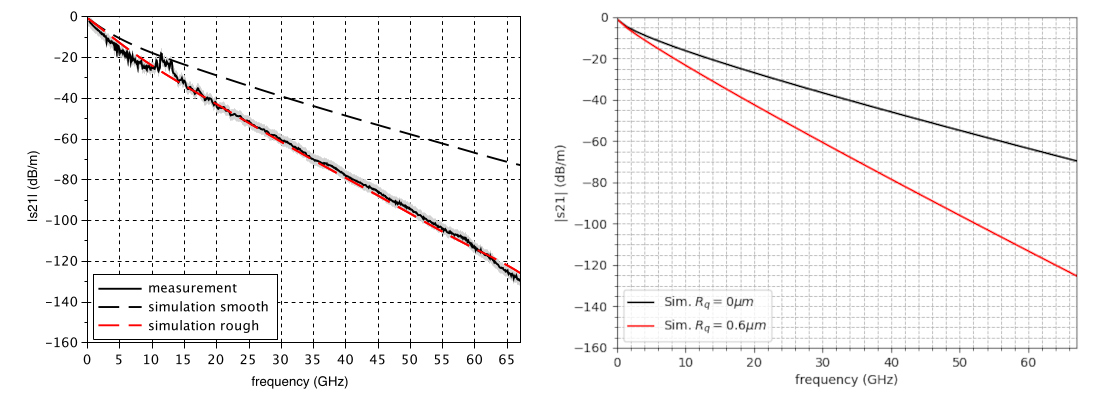
Measured and modeled stripline loss from gradient model paper (left), and same simulation in my simulator (right).
I tested it against few simulations and measurements with good accuracy. Above is example stripline measurement using the surface roughness model compared against the measurement in Gradient model paper (Figure 23 in the paper). The loss of the stripline calculated with my simulator matches very well. Effective permittivity rise due to increased inductance from the roughness is also simulated well. Click here to open these parameters in the simulator.
I have more tests in source code tests folders against various single-ended and differential transmission lines that are tested against other simulators or measurements. Solved characteristic impedances, RLGC parameters, and losses all currently agree well with the reference simulation or measurements.
More detailed computation method description and limitations of the method are in "About" tab of the program.
Conclusion
Click the image above to open the simulator. The source code is available on GitHub.